23 September
Ecommerce Development / Retail Technology
Unified Retail Architecture: Synchronizing POS, ERP and Shopify in Real Time
Every omnichannel retail operation is vulnerable to the same critical failure point: a customer orders the last pair of boots online for in-store pickup, while sixty seconds prior, an in-store shopper brought that exact item to the register.
When digital and physical inventory don’t reflect each other instantaneously, the consequences are immediate: cancelled orders, stockouts, frustrated store associates, and broken customer trust.
According to Shopify’s research on unified retail commerce, operators running truly unified commerce architectures see up to 23% higher inventory turnover and 1.5 times higher customer lifetime value (LTV) compared to their non-unified peers. Yet for scaling brands and multi-location retailers, moving from legacy batch synchronization to true real-time unification remains one of engineering’s toughest challenges.
Here is an architectural breakdown of why traditional retail synchronization fails—and how modern retail engineering solves it.
The Root Problem: The Latency Trap of Batch Syncs
Most multi-channel retailers still rely on periodic polling or scheduled batch jobs (e.g., syncing every 15, 30, or 60 minutes) to reconcile physical store sales with online catalogs.
While batch processing made sense in the era of daily night-audit batch files, modern retail workflows—such as Buy Online, Pick Up In-Store (BOPIS), Ship-from-Store, and cross-channel returns—break under that latency.
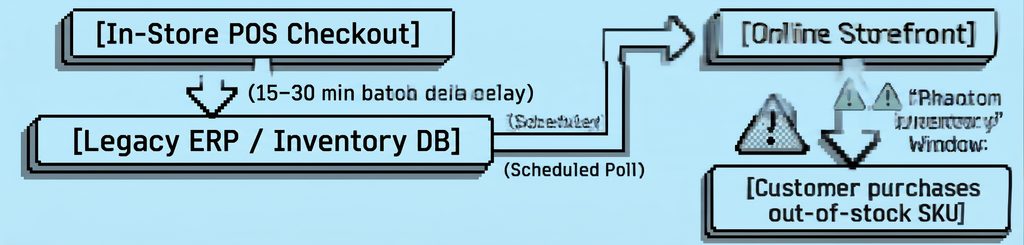
This lag creates a phantom inventory window:
- Overselling: Online customers purchase stock already ringed up in-store.
- Buffer Bloat: Merchandisers hold artificial “safety buffers” online, artificially suppressing digital revenue to avoid stockouts.
- Fulfillment Deadlocks: Store associates waste manual labor looking for physical units that left the building an hour ago.
As outlined in Shopify’s analysis of real-time inventory management, removing these manual discrepancies and moving to centralized real-time inventory visibility can save teams dozens of hours per month while driving up to 40% higher in-store conversion rates through accurate local availability.
Anatomy of a Modern, Event-Driven Retail Architecture
Eliminating sync delays requires shifting away from polling and moving toward an event-driven, decoupled integration layer.
In high-volume enterprise retail environments, your systems of record (POS, ERP, and Storefront) should not talk directly via brittle, point-to-point connections. Instead, they interact via an intermediary orchestration layer:
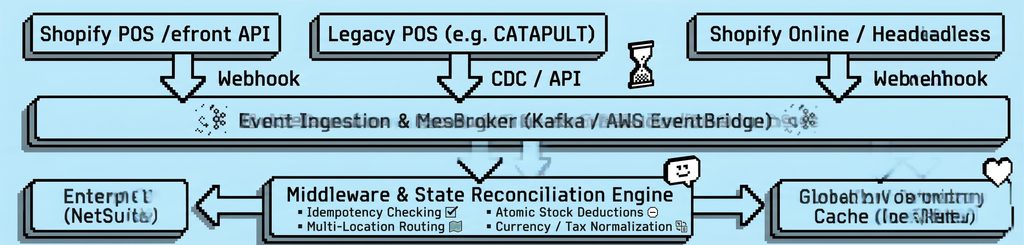
1. Webhooks & Change Data Capture (CDC)
Rather than asking the POS every 10 minutes if an item sold, transactions trigger instant events:
- When a register prints a receipt or confirms a payment, an immediate transaction event publishes to an ingestion gateway.
- For legacy POS appliances that lack native webhooks, CDC agents watch database transaction logs and emit events the moment a line item commits.
2. Idempotent Message Broker
Network drops and retry mechanisms are inevitable in brick-and-mortar retail (e.g., store Wi-Fi hiccups). An event queue (such as AWS SQS, EventBridge, or Apache Kafka) guarantees that messages:
- Are not dropped during spikes (e.g., Black Friday rushes).
- Maintain exact ordering where necessary.
- Feature unique deduplication keys so a retried payload doesn’t decrement an item twice.
3. Atomic Location-Level State Management
Using Shopify’s multi-location inventory APIs, stock deductions must be routed atomically to the specific fulfillment node. This ensures that physical brick-and-mortar stock, centralized fulfillment warehouses, and 3PL distribution centers are segregated cleanly within the inventory graph.
Where Off-the-Shelf Apps Hit a Wall
Many merchants begin with third-party sync apps available on public marketplaces. For a single boutique with one or two POS terminals, off-the-shelf connectors often suffice.
However, scaling mid-market and enterprise retailers encounter architectural ceilings:
- API Rate Limiting: High-frequency sales during flash events or holiday weekends easily overwhelm generic sync apps, causing backlog queues to cascade into multi-hour delays.
- Complex Multi-Location Logic: Custom split-ship rules, reserve-for-in-store thresholds, and custom lot tracking rarely map cleanly to standard out-of-the-box configurations.
- Specialized POS Systems: Retailers operating enterprise POS platforms—such as ECRS CATAPULT in grocery and specialty retail, or legacy NetSuite POS—require bi-directional data pipelines that accommodate complex hardware peripherals, scale weights, tare weights, and loyalty balances.
How Orafox Bridges the Retail Tech Gap
At Orafox, we specialize in designing and engineering resilient, enterprise-grade digital retail architectures. Rather than forcing your business into rigid off-the-shelf software, our engineering team builds custom integration layers that connect disparate retail touchpoints into a unified engine:
- Custom High-Concurrency Middleware: We architect custom microservices and serverless pipelines (Node.js, Python, AWS, GCP) designed to ingest POS transaction logs, execute atomic inventory adjustments, and handle thousands of concurrent checkouts without lag.
- Legacy POS & ERP Unification: Whether connecting specialized grocer POS engines like ECRS CATAPULT or enterprise backends like SAP and NetSuite into modern Shopify Plus environments, we handle data mapping, webhook queues, and protocol translations.
- Headless & Omnichannel Commerce: We construct high-performance frontends (React, Next.js, Progressive Web Apps) wired directly into unified inventory caches, delivering true real-time BOPIS, curbside pickup, and localized catalog views to your customers.
The Verdict: Unification is an Architecture, Not a Feature
Real-time retail synchronization isn’t solved by installing another plugin; it’s an architectural commitment to treating all inventory as a single, dynamic state machine.
By pairing modern platforms like Shopify with tailored, event-driven middleware, retailers eliminate the friction of phantom inventory, free their store associates to focus on customer service, and unlock higher margins across every sales channel.
Is your team grappling with inventory discrepancies, slow batch syncs, or complex POS integrations? Reach out to the engineering team at Orafox to audit your retail stack and engineer a modern, scalable architecture.