19 August
Ecommerce Development / Mobile Apps Development / Retail Technology / Website Design & Development
Why 2026 Belongs to Agentic Workflows: Moving Beyond Wrapper Chatbots in Custom Enterprise Apps
The era of the novelty chatbot is officially over.
For the past three years, enterprise software saw an influx of “AI features”—most of which were little more than lightweight UI wrappers around foundation LLM APIs. While conversational interfaces delivered quick wins for basic summarization and simple customer Q&A, they quickly hit a ceiling: they don’t do the work. They offer advice, but they cannot execute.
In 2026, competitive advantage belongs to enterprises deploying Agentic AI—systems capable of autonomous reasoning, bounded decision-making, API orchestration, and real-time execution across proprietary databases and legacy software.
Here is why agentic workflows are reshaping enterprise software architecture, the technical barriers that keep off-the-shelf SaaS from delivering, and how Orafox engineers production-grade agentic platforms for the modern enterprise.
1. The Architectural Shift: Passive Chat vs. Autonomous Agents
To understand why custom engineering is critical, it helps to contrast traditional conversational AI with an agentic state machine:
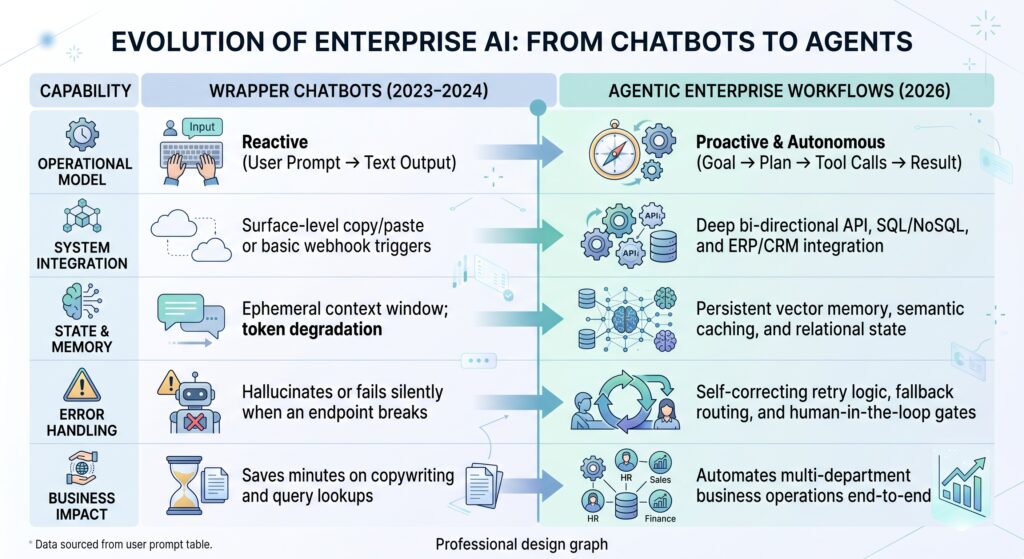
An enterprise agent does not just inform an operator that an invoice is overdue; it parses the ERP ledger, checks historical dispute logs, verifies shipping confirmations via a carrier API, drafts the customized resolution, and triggers payment gateway adjustments within predefined risk thresholds.
2. Why Off-the-Shelf SaaS Falls Short
Packaged enterprise software tools promise “turnkey AI,” but they inevitably run into structural roadblocks when introduced to real-world corporate environments:
- Siloed Domain Logic: Generic AI platforms lack visibility into proprietary business rules, custom schema variations, and internal edge cases accumulated over years of operations.
- Security & Data Sovereignty: Commercial SaaS wrappers often route prompts through third-party multi-tenant endpoints, conflicting with SOC 2, HIPAA, or strict zero-trust data governance standards.
- Context Drift & Runaway Costs: Unoptimized LLMOps pipelines waste compute by feeding raw, uncompressed schemas into expensive models rather than using deterministic code for standard execution.
Turning an LLM into an operational asset requires custom software architecture—middleware that coordinates state, authenticates API handshakes, enforces guardrails, and manages model latency.
3. The Core Anatomy of an Enterprise Agentic Architecture
When architecting autonomous workflows, enterprise development teams focus on four key technical layers:
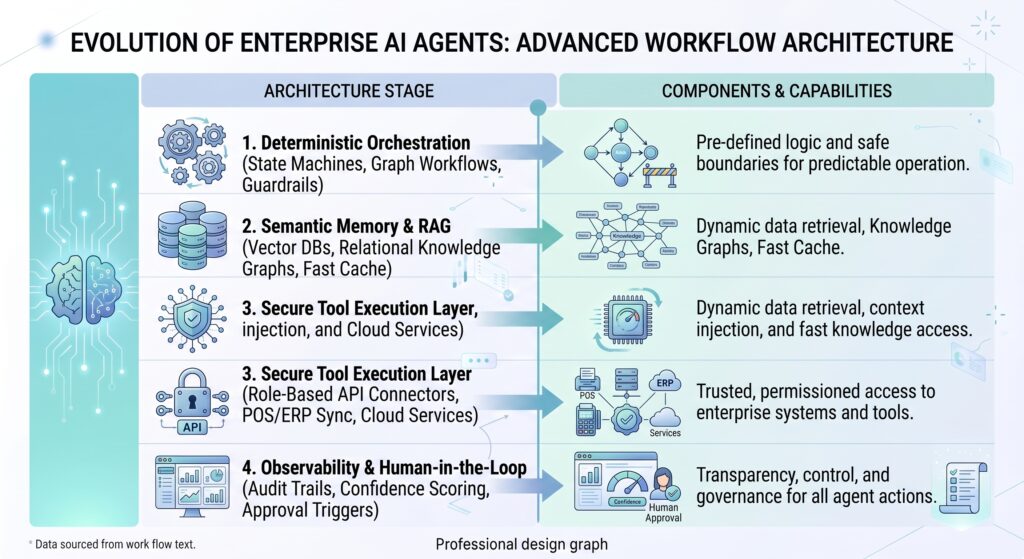
- Deterministic Orchestration: Implementing frameworks like LangGraph or custom finite-state machines to ensure the AI follows structured, predictable execution paths rather than free-wheeling loops.
- Context & Hybrid Retrieval: Combining dense vector search with structured SQL queries and knowledge graphs to provide the model with 100% accurate, real-time enterprise context.
- Bounded Tool Execution: Providing agents with sandboxed, role-scoped API tokens so they can perform specific actions (e.g., updating a warehouse inventory count or scheduling field technicians) safely.
- Human-in-the-Loop (HITL) Triggers: Setting algorithmic confidence thresholds where ambiguous or high-financial-impact operations automatically flag an engineer or manager for approval before firing.
4. How Orafox Architects Custom Agentic Solutions
At Orafox, we don’t build generic AI bolt-ons. We engineer high-performance, tailored applications and modernization layers that turn complex manual workflows into self-driving business systems.
Whether modernizing legacy infrastructure or building a new digital product from scratch, Orafox partners with engineering and operations leaders to deliver:
Custom API & Legacy System Modernization
Most enterprises run on mission-critical legacy databases, proprietary ERPs, and custom internal tools. Orafox builds robust, secure API layers and composable middleware that allow modern AI agents to interact cleanly with legacy backends without disrupting ongoing operations.
End-to-End Autonomous Pipeline Engineering
From intelligent document ingestion to multi-tier automated customer operations, Orafox designs end-to-end architectures. We select the optimal model tier for each sub-task—pairing lightweight, on-device Small Language Models (SLMs) for high-speed deterministic routing with frontier reasoning models for complex planning—keeping latency near zero and infrastructure costs low.
Enterprise-Grade Security & Zero-Trust Integration
Data privacy is non-negotiable. Orafox implements strict role-based access controls (RBAC), end-to-end encryption, local semantic caching, and private cloud deployments (AWS, GCP, Azure) to guarantee that proprietary enterprise intelligence never leaks into public training pipelines.
Production Observability & Resilience
We build comprehensive monitoring suites with real-time audit logging, token telemetry, automated rollback mechanisms, and intuitive administrative dashboards, ensuring leadership maintains full visibility and control over autonomous operations.
Moving from Strategy to Deployment
The transition from basic chatbot experiments to enterprise-grade agentic software requires engineering rigor, deep system integration expertise, and a clear architectural roadmap.
If your team is evaluating how to automate complex internal processes, replace repetitive manual workflows, or build next-generation AI-powered software, Orafox provides the technical expertise and dedicated development teams needed to turn vision into scalable production software.
Ready to Build Autonomous Workflows That Drive Measurable ROI?
[Schedule an AI Architecture Consultation with Orafox] to review your current tech stack, identify high-impact automation targets, and map out a custom engineering roadmap.